Solution

LiDAR application solution for robot drop prevention and obstacle avoidance

Use downward floor distance and forward obstacle distance as separate inputs for robot slowdown and stop actions.

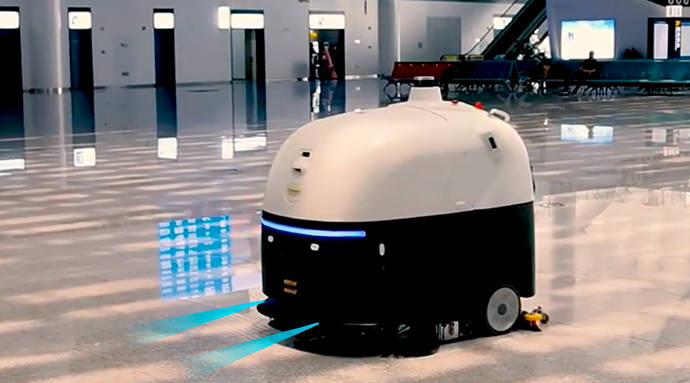
Service robot using downward distance sensing for drop prevention and obstacle avoidance

Scenario

Application scenario

Robot drop prevention and obstacle avoidance are related but distinct tasks: downward sensing looks for floor discontinuities, while forward sensing measures obstacle distance. Mounting, floor or target material, speed, and control latency determine safe actions.

Engineering problem

  • Sensor-to-edge geometry determines the available warning time.
  • Dark, glossy, or highly reflective floors can produce different returns.
  • Ramps and thresholds must be distinguished from a real drop.

Why LiDAR

A downward-looking LiDAR can provide continuous floor-distance change for detecting discontinuities. Speed and control latency still determine the safe action.

Workflow

  1. Define the minimum edge, travel speed, and required reaction distance.
  2. Set a downward mounting point and angle that covers the front edge of the chassis.
  3. Establish a normal floor baseline and design change thresholds and debounce logic.
  4. Validate carpet, tile, dark floors, ramps, and steps separately.

Technology comparison and selection

DimensionConditionLiDARAlternativeAlternative performanceConclusion
Step and edge change detectionCompare on the real target, mounting path, environment, control logic, and project acceptance criteria; do not compare nominal maximum range alone.Provides distance-change input in planned downward-looking measurement geometry.Mechanical drop-prevention structure / contact switchUsually act after physical contact or a specific structural state.

Range input, travel speed, stopping logic, and mechanical safety measures must be designed together.

公开来源公开来源 · Verified 2026-08-24

Scroll horizontally to view all columns

Installation and integration

  • Define the target, measurement axis, occlusion, wiring, and mounting space first; connect the current product manual to the target controller and record the model, interface, orientation, offset, and delivered revision.

    Robot drop-prevention solution · Target controller or host system · Target hardware and software release verified before deploymentTF-NOVA Datasheet · Verified 2026-08-24
  • Before connecting business control logic, validate healthy data, timeout handling, stop behavior, and fallback with real targets, worst-case distance, ambient light, and motion.

    Robot drop-prevention solution · Target controller or host system · Field procedure and fault handling verified on the target systemTF-NOVA Datasheet · Verified 2026-08-24

Operating limits

  • LiDAR provides distance or spatial-sensing input and does not by itself provide system positioning, safety integrity, braking, flight-stack fusion, or business outcomes; design and validate those functions separately on the target system.

    Robot drop-prevention solutionTF-NOVA Datasheet · Verified 2026-08-24

Evidence

Research, ecosystem and customer stories

TFmini in a bionic hexapod robot field study

Institution
North Carolina State University, Department of Biological Sciences
Model
—
Use
The paper lists TFmini alongside other sensors in a hexapod-robot study.
Provenance
Development of a bionic hexapod robot with adaptive gait and clearance for enhanced agricultural field scouting 2024 DOI: 10.3389/frobt.2024.1426269
Attribution
Brand-level: Benewake named in the source
Open original source ↗View evidence citation →

Sources

Supporting sources

Verifiable TF-NOVA reference

Verifies horizontal coverage and ranging conditions for a field-validation checklist. The current public material supports verification of sensor specifications and interfaces; it does not establish vehicle-level performance, system safety level, or project results.

Use the stated target, reflectivity, ambient-light, mounting, and delivered-revision conditions; revalidate in the field.

TF-NOVA Datasheet

Verifiable TF-Luna reference

Verifies single-point range input material and delivery conditions. The current public material supports verification of sensor specifications and interfaces; it does not establish vehicle-level performance, system safety level, or project results.

Use the stated target, reflectivity, ambient-light, mounting, and delivered-revision conditions; revalidate in the field.

TF-Luna Datasheet

Verifiable TFmini Plus reference

Verifies compact-integration material and interface conditions. The current public material supports verification of sensor specifications and interfaces; it does not establish vehicle-level performance, system safety level, or project results.

Use the stated target, reflectivity, ambient-light, mounting, and delivered-revision conditions; revalidate in the field.

TFmini Plus Datasheet

FAQ

Frequently asked questions

Can robot drop prevention use one fixed distance threshold?

Not reliably. Normal floor distance changes with mounting, attitude, ramps, and material. Establish a site baseline and combine change magnitude, duration, speed, and control latency.

Resources

Resources and references

Confirm the selection with real mission conditions

Share the operating height, target surface, environment, mounting space, and flight-stack version. Our engineering team can help plan selection and validation.

Talk to an engineer

Product inquiry

Talk to a product specialist

Tell us what you need and our team will get back to you.

Product inquiry

Inquiry sent

Your inquiry has been received. We will be in touch soon.