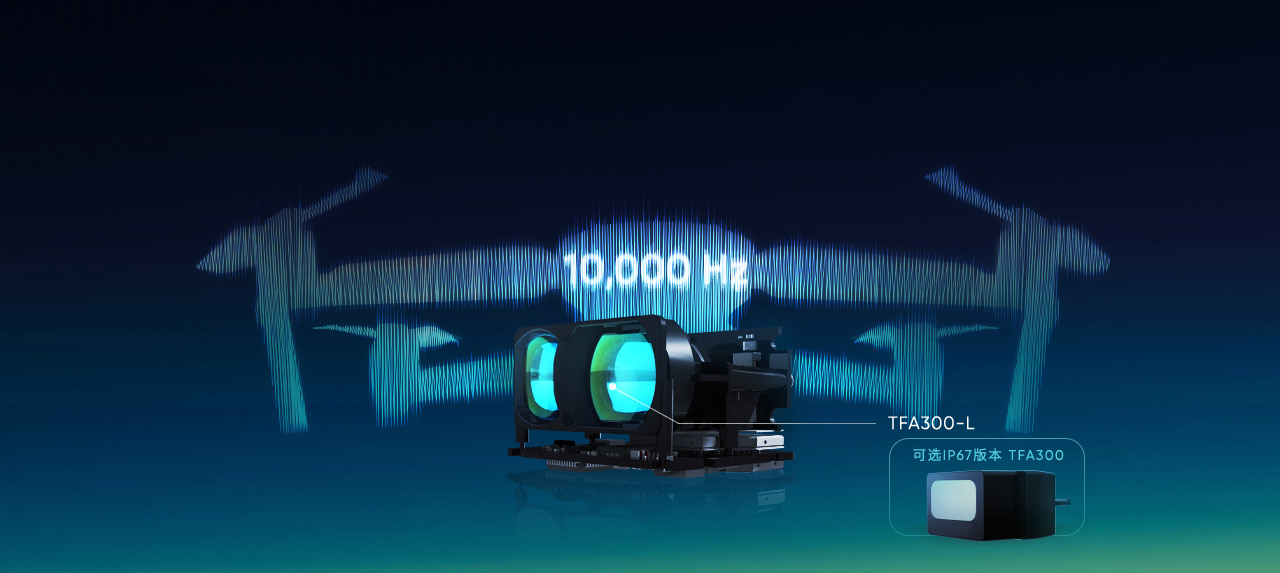

TFA300 Series10,000 Hz Ultra High-Frequency Drone Altitude Sensor & Gimbal Rangefinder
TFA300 series targets high-update-rate single-point input on UAVs and gimbals. Check payload and protection separately for enclosed TFA300 and unenclosed TFA300-L.
Key specifications
- Frame rate
- 1 ~ 10,000 Hz
- Interface
- UART,CAN
- TFA300 measuring range
- 270 m @ 90%
- TFA300 protection
- IP67
- TFA300-L measuring range
- 290 m @ 90%
- TFA300-L protection
- No protection
Need help confirming a selection or purchase details?
Applications

Full specifications
| Parameter | Value | Parameter | Value |
|---|---|---|---|
| Detecting accuracy | ± 10 cm (<10 m)1% (≥ 10 m) | Frame rate | 1 ~ 10,000 Hz |
| Interface | UART,CAN | Power consumption | ≤ 0.45 W |
| Field of view | < 0.5° | Output data | Single-point Distance Value |
| Operating voltage | DC 5 V ± 10% | TFA300 measuring range | 270 m @ 90% |
| TFA300 protection | IP67 | TFA300-L measuring range | 290 m @ 90% |
| TFA300-L protection | No protection | TFA300 dimensions | 49.4 mm × 37.0 mm × 28.6 mm |
| TFA300 weight | 35.5 g | TFA300-L dimensions | 32.0 mm × 30.2 mm × 20.2 mm |
| TFA300-L weight | 10.5 g |
Applicable scope and usage limits
Applicable scenarios
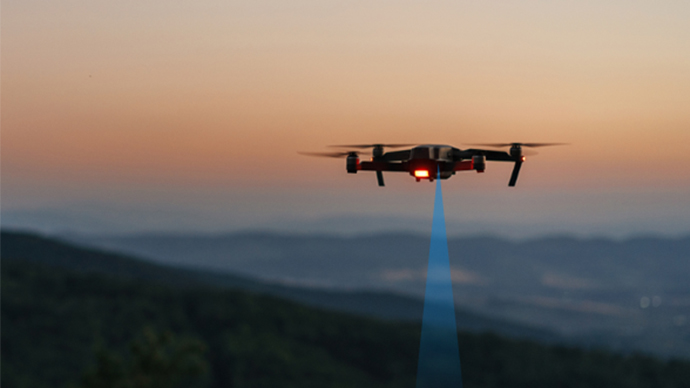
- Evaluate TFA300 series when a UAV or EO/IR gimbal needs a high-rate sight-line distance over UART or CAN.
- It feeds flight-control, focus or measurement algorithms;
- the host system implements the task outcome.
Conditions
- First identify enclosed TFA300 versus unenclosed TFA300-L, then check range, mass, protection and available output rate in that variant's documentation.
- Maximum frequency is not a promise at every range condition.
Not applicable scenarios
- For lower-rate kilometer-class ranging, compare TFA1200-L or the relevant TFA1500-L mode.
- For surrounding contours or 3D point clouds, compare scanning or 3D products.
- Do not mix the weight, range and enclosure specifications of TFA300 and TFA300-L.
Long-range single-point sensing: payload, interfaces and feedback speed
Define target size, working distance and required valid-range interval before comparing payload, enclosure and interfaces. Directional range feeds flight-control, focus or positioning algorithms; it is not a 3D survey or complete obstacle-avoidance result.
View comparison topicMass comes first, with host enclosure and integration
The approximately 10 g TFA170-L suits payload-sensitive long-range directional input with host-provided protection and power.
Boundary: Check RS-232, 12 V and the delivered version's output rate. Compare TF03 for an enclosure and other interface choices.
View model detailsOutdoor enclosure and multiple interface choices
Compare TF03 when about 86 g is acceptable and IP67 with a compatible interface is needed for a defined target direction.
Boundary: Check range and interface variants separately. If shorter-range models already meet the real distance, compare their lower mass too.
View model detailsHigh update rate with variant-specific enclosure choices
Compare TFA300 series for high-rate UAV or gimbal range input, choosing enclosure versus payload by hardware variant.
Boundary: Do not combine TFA300-L mass and range with TFA300 IP67 into one specification. Check output rate for the same variant.
View model detailsAdditional distance warrants a larger platform load
Compare TF350 when a fixed or larger platform needs more directional distance and can accept about 224 g and its mounting volume.
Boundary: Validate target size, optical-axis jitter and mounting rigidity for the narrow field. For shorter tasks, compare the system benefit of lighter models.
View model details| Parameter | TFA170-L | TF03 | TFA300 Series | TF350 |
|---|---|---|---|---|
| Measuring range | 0.1 ~ 170 m | 0.1 ~ 180 m | — | 0.2 ~ 350 m |
| Detecting accuracy | ± 10 cm (< 10 m), 1% (≥ 10 m) | ± 10 cm (≤ 10 m)1% (> 10 m) | ± 10 cm (<10 m)1% (≥ 10 m) | ± 10 cm (≤ 10 m)1% (> 10 m) |
| Frame rate | 1 ~ 1000 Hz | 1 ~ 9800 Hz | 1 ~ 10,000 Hz | 1 ~ 9800 Hz |
| Interface | RS-232 | UART,CAN,RS-232,RS-485 | UART,CAN | UART,CAN,RS-232,RS-485 |
| Protection | without enclosure | IP67 | — | IP67 |
| Dimensions | 31.0 mm × 30.2 mm × 19.2 mm | 44 mm × 43 mm × 32 mm | — | 78 mm × 67 mm × 40 mm |
| Power consumption | ≤ 1 W | ≤800 mW | ≤ 0.45 W | ≤ 1 W |
| Weight | ~ 10 g | 86 ± 3 g | — | 224 ± 3 g |
| Field of view | < 0.5° | 0.5° | < 0.5° | 0.35° |
| Operating voltage | DC 12 ± 10% V | 5 ~ 24 V | DC 5 V ± 10% | 5 ~ 24 V |
FAQ
What is the maximum measurement range of the TFA300?
The TFA300 achieves 270 m at 90% reflectivity in 100 KLux ambient light, while the TFA300-L variant extends this to 290 m under the same conditions. At lower reflectivity (10%), range drops to 90 m for TFA300 and 100 m for TFA300-L. Minimum blind zone is ≤0.1 m.
What communication protocols does the TFA300 support?
The TFA300 supports both UART and CAN protocols, switchable by command. Default UART baud rate is 115,200 bps (configurable), with 8 data bits, 1 stop bit, and no parity. JST GH 1.25 mm 6-pin connector is used for all connections.
Which tasks suit TFA300 Series, and why choose it?
Evaluate TFA300 series when a UAV or EO/IR gimbal needs a high-rate sight-line distance over UART or CAN. It feeds flight-control, focus or measurement algorithms; the host system implements the task outcome.
What are the accuracy and precision specifications?
Accuracy is ±10 cm for distances less than 10 m, then ±1% for distances 10 m and beyond. Repeatability is excellent at <3 cm (1σ), ensuring consistent measurements across repeated measurements. Distance resolution is 1 cm, enabling fine-grain obstacle detection.
What are the operating environment limits?
TFA300 series specifies -20°C to +60°C operation. The enclosed TFA300's IP67 must not be applied to unenclosed TFA300-L, which requires host protection. Check usable distance in rain, fog, window contamination and strong light against the actual variant and target conditions.
What power supply does the TFA300 require?
The TFA300 requires DC 5V ±10% input with average power consumption of ≤0.45 W and peak current <0.75 A (measured at 25°C, 50 Hz). Low power draw makes it suitable for battery-powered systems and embedded IoT applications without heavy charging infrastructure.
What are the physical dimensions and weight?
First distinguish enclosed TFA300 from unenclosed TFA300-L. The current official page lists TFA300-L at about 10.5 g and 32.0 × 30.2 × 20.2 mm; confirm enclosed dimensions and weight for the delivered version. Sources differ on enclosed weight, so do not combine unenclosed mass with enclosed protection.
When should an alternative to TFA300 Series be considered?
For lower-rate kilometer-class ranging, compare TFA1200-L or the relevant TFA1500-L mode. For surrounding contours or 3D point clouds, compare scanning or 3D products. Do not mix the weight, range and enclosure specifications of TFA300 and TFA300-L. First identify enclosed TFA300 versus unenclosed TFA300-L, then check range, mass, protection and available output rate in that variant's documentation. Maximum frequency is not a promise at every range condition.
How should TFA300 Series be compared with other models or sensing approaches?
Distinguish TFA300 from TFA300-L by enclosure and payload requirements before comparing interfaces, update rates and target-dependent range against products such as TF03. Series maxima cannot be combined into one model's specification.
What platforms and systems does it integrate with?
TFA300 series offers UART and CAN for flight controllers, gimbals and embedded controllers with suitable drivers and protocol support. Confirm connector, electrical levels, protocol and output period for the selected variant and firmware. CAN support does not by itself establish CAN FD compatibility or driver-free use on every platform.
