Solution

LiDAR application solution for overhead crane positioning and obstacle avoidance

Provide long-range position or separation input for overhead cranes to support travel zones, slowdown, and obstacle-avoidance logic.

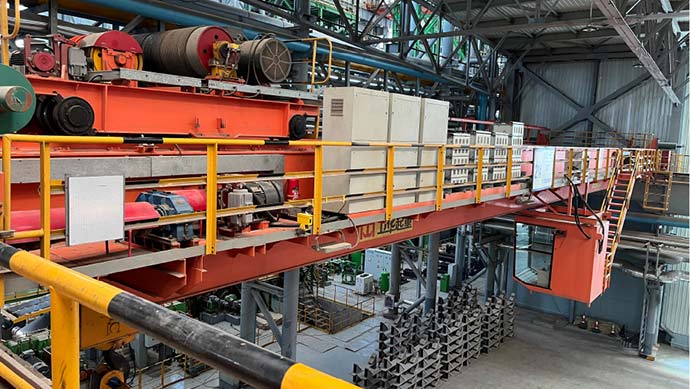
Overhead crane operating inside an industrial plant

Scenario

Application scenario

Overhead-crane positioning and obstacle avoidance need a stable target, clear path, and known coordinate reference. Distance supports travel and obstacle logic but does not replace limit switches, redundancy, or safety control.

Engineering problem

  • Swing, vibration, and structural occlusion can change the measurement direction.
  • Target size, angle, and surface affect long-range returns.
  • Positioning, limit functions, and safety anti-collision need layered and redundant control.

Why LiDAR

Long-range LiDAR provides direct distance between equipment and a target for travel zones, slowdown points, and separation monitoring.

Workflow

  1. Define the measurement axis, target, maximum travel, and control safety zones.
  2. Design rigid mounting, vibration control, and an unobstructed path.
  3. Integrate distance and status into the PLC for travel, slowdown, and fault handling.
  4. Validate full travel, swing, dust, and worst expected lighting.

Technology comparison and selection

DimensionConditionLiDARAlternativeAlternative performanceConclusion
Long-range travel and separationCompare on the real target, mounting path, environment, control logic, and project acceptance criteria; do not compare nominal maximum range alone.Provides target-distance input along a defined measurement axis.Encoder / limit switch / wireless positioningProvide shaft position, point triggering, or system location from different references.

Combine technologies by positioning accuracy, safety integrity, and redundancy; do not substitute LiDAR for safety limits.

公开来源公开来源 · Verified 2026-08-24

Scroll horizontally to view all columns

Installation and integration

  • Define the target, measurement axis, occlusion, wiring, and mounting space first; connect the current product manual to the target controller and record the model, interface, orientation, offset, and delivered revision.

    Crane-positioning solution · Target controller or host system · Target hardware and software release verified before deploymentTF03 Series Datasheet · Verified 2026-08-24
  • Before connecting business control logic, validate healthy data, timeout handling, stop behavior, and fallback with real targets, worst-case distance, ambient light, and motion.

    Crane-positioning solution · Target controller or host system · Field procedure and fault handling verified on the target systemTF03 Series Datasheet · Verified 2026-08-24

Operating limits

  • LiDAR provides distance or spatial-sensing input and does not by itself provide system positioning, safety integrity, braking, flight-stack fusion, or business outcomes; design and validate those functions separately on the target system.

    Crane-positioning solutionTF03 Series Datasheet · Verified 2026-08-24

Sources

Supporting sources

Verifiable TF03 reference

Current material verifies long-range ranging, interfaces, and protection-related material; it does not represent crane safety performance. The current public material supports verification of sensor specifications and interfaces; it does not establish vehicle-level performance, system safety level, or project results.

Use the stated target, reflectivity, ambient-light, mounting, and delivered-revision conditions; revalidate in the field.

TF03 Series Datasheet

FAQ

Frequently asked questions

Can mechanical limit switches be removed after adding LiDAR to a crane?

Not by default. LiDAR can provide travel or separation input, but safety limits, redundancy, fault handling, and control integrity must be designed independently.

Resources

Resources and references

Confirm the selection with real mission conditions

Share the operating height, target surface, environment, mounting space, and flight-stack version. Our engineering team can help plan selection and validation.

Talk to an engineer

Product inquiry

Talk to a product specialist

Tell us what you need and our team will get back to you.

Product inquiry

Inquiry sent

Your inquiry has been received. We will be in touch soon.