
Products3D LiDAR

AD2-S-X3

AD2-S-X3Industrial-Grade 3D LiDAR Sensor for Infrastructure and Traffic Safety

AD2-S-X3 supplies long-range 3D point clouds to platforms needing distant spatial structure and able to support its power, automotive Ethernet and computing requirements.

Key specifications

Measuring range
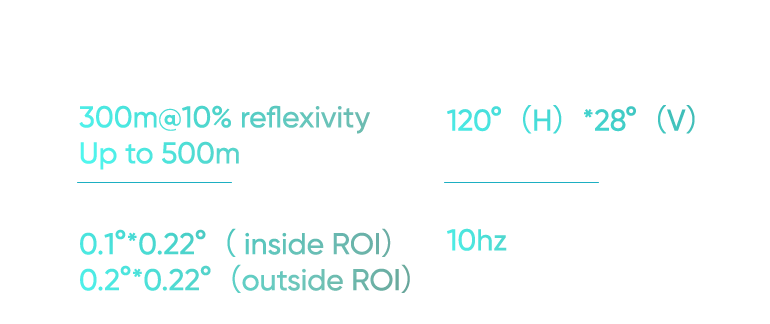
300 m @ 10%
Frame rate
10 Hz
Interface
1000Base-T1 Automotive Ethernet
Protection
IP67 & IP6K9K

Need help confirming a selection or purchase details?

Full specifications

Product technical specifications
ParameterValueParameterValue
Measuring range300 m @ 10%Detecting accuracy5 cm @ 1 σ
Frame rate10 HzInterface1000Base-T1 Automotive Ethernet
ProtectionIP67 & IP6K9KDimensions49 mm × 160 mm × 144 mm
Power consumption≤ 15 WWeight1.2 kg
Field of view120° × 28°Output data3D Point Cloud
Operating voltage9 ~ 32 V

Applicable scope and usage limits

Applicable scenarios

  • Evaluate AD2-S-X3 when a mobile platform needs distant 3D positions and scene structure and can supply power, 1000Base-T1 connectivity and point-cloud processing.
  • It supplies perception data;
  • recognition and motion decisions remain host functions.

Conditions

  • Confirm field of view, resolution, update rate and target conditions for the actual mode, then validate 1000Base-T1 integration, processing, synchronization and mounting coverage.
  • Application descriptions do not replace project-specific certification evidence.

Not applicable scenarios

  • For nearby package or obstacle surfaces, compare LR10 series.
  • For one range value or a planar contour, compare single-point or 2D products.
  • A small platform with strict payload and power limits should not add 3D system overhead solely for maximum range.

3D sensing: nearby surfaces versus distant spatial targets

Nearby package or robot-surround surface data and distant 3D targets are different selection tasks. Define distance, target size and required information, then assess field coverage, interfaces, computing and platform load. Compare 2D when a planar contour is sufficient.

View comparison topic
AD2-S-X3Current model

Distant 3D targets on a capable host platform

Compare AD2-S-X3 for more distant 3D positions and scene structure when power, automotive Ethernet and point-cloud processing are available.

Boundary: It is not a direct substitute for ordinary Ethernet equipment. Check field, resolution and rate by mode, plus platform power and payload.

View model details
LR10 series

Nearby surfaces, occupancy and volume data capture

Compare LR10 series when nearby point clouds and RGB feed package-shape or robot-surround object analysis.

Boundary: Check interface and mounting for the specific model. Volume or people-count results also depend on coverage, calibration and downstream algorithms.

View model details
Key parameter comparison
ParameterAD2-S-X3LR10 series
Output data3D Point CloudPoint cloud&RGB
Measuring range300 m @ 10%0.05-18m
Field of view120° × 28°70°×120°
Frame rate10 Hz10fps
Detecting accuracy5 cm @ 1 σ≤3cm
Interface1000Base-T1 Automotive EthernetEthernet,GMSL,I/O
ProtectionIP67 & IP6K9KIP67
Dimensions49 mm × 160 mm × 144 mm92 mm × 47 mm × 51 mm
Weight1.2 kg460g
Power consumption≤ 15 W—
Operating voltage9 ~ 32 V24V

FAQ

What is the measurement range of the AD2-S-X3?

The AD2-S-X3 achieves a maximum detection range of 300m at 10% reflectivity under outdoor 100Klux ambient light conditions, with a minimum detectable range of ≤1.2m. Range performance may vary based on target reflectivity, environmental conditions, and ambient light levels.

What communication interfaces does the AD2-S-X3 support?

The AD2-S-X3 uses 1000Base-TX Ethernet for data transmission with UDP protocol. Power is supplied via M12 Acode 4PIN connector, and data is output through M12 Xcode 8PIN interface. Time synchronization is supported via gPTP, PTP, and NTP protocols.

Which tasks suit AD2-S-X3, and why choose it?

Evaluate AD2-S-X3 when a mobile platform needs distant 3D positions and scene structure and can supply power, 1000Base-T1 connectivity and point-cloud processing. It supplies perception data; recognition and motion decisions remain host functions.

What are the accuracy and precision specifications?

The AD2-S-X3 provides 3cm accuracy at 1σ (standard deviation), measured at an ambient temperature of 25°C. Precision may vary due to detection range, target reflectivity, and environmental conditions. The sensor delivers ultra-high angular resolution of 0.1°×0.22° in ROI regions and 0.2°×0.22° in non-ROI regions.

What is the operating environment rating and temperature range?

The AD2-S-X3 operates in temperatures from -40°C to +85°C and stores between -40°C to +105°C, providing strong environmental adaptability. It features IP67 dust/water protection and IP6K9K high-pressure jet protection, making it suitable for harsh outdoor industrial and transportation environments.

What power supply does the AD2-S-X3 require?

The AD2-S-X3 requires an operating voltage of 9-32V, with average power consumption of ≤15W. This wide input voltage range allows flexible integration with automotive (12V/24V) and industrial power systems, while low power consumption minimizes thermal and electrical load.

What are the physical dimensions and weight?

The AD2-S-X3 measures 206.5mm (W) × 156.1mm (D) × 61.4mm (H) and weighs 1.2kg, making it compact enough for vehicle-mounted and stationary industrial installations. Its curved top design is optimized for aerodynamic mounting on automotive platforms.

When should an alternative to AD2-S-X3 be considered?

For nearby package or obstacle surfaces, compare LR10 series. For one range value or a planar contour, compare single-point or 2D products. A small platform with strict payload and power limits should not add 3D system overhead solely for maximum range. Confirm field of view, resolution, update rate and target conditions for the actual mode, then validate 1000Base-T1 integration, processing, synchronization and mounting coverage. Application descriptions do not replace project-specific certification evidence. If the project requires functional-safety certification, verify the corresponding evidence separately; Class 1 laser eye safety is not functional-safety certification.

How should AD2-S-X3 be compared with other models or sensing approaches?

AD2-S-X3 targets longer-range 3D sensing, while LR10 addresses nearby point-cloud/RGB tasks, with different interfaces and platform loads. Compare target distance, coverage and host resources without unverified same-condition competitor superiority claims.

What platforms and systems does the AD2-S-X3 integrate with?

The AD2-S-X3 supports Windows, Linux (Ubuntu), and ROS (Robot Operating System) platforms via native drivers. Ethernet UDP transmission enables integration with industrial controllers, PLC systems, and embedded computing platforms. Standard gPTP/PTP/NTP synchronization ensures precise timestamping for multi-sensor fusion in autonomous systems and industrial applications.

Product inquiry

Talk to a product specialist

Tell us what you need and our team will get back to you.

Product inquiry

Inquiry sent

Your inquiry has been received. We will be in touch soon.