
Applicable scenarios
Suitable for long-range UAV measurement, inspection and engineering surveying.
Condition: Bounded by the range, accuracy and operating conditions in the product datasheet.
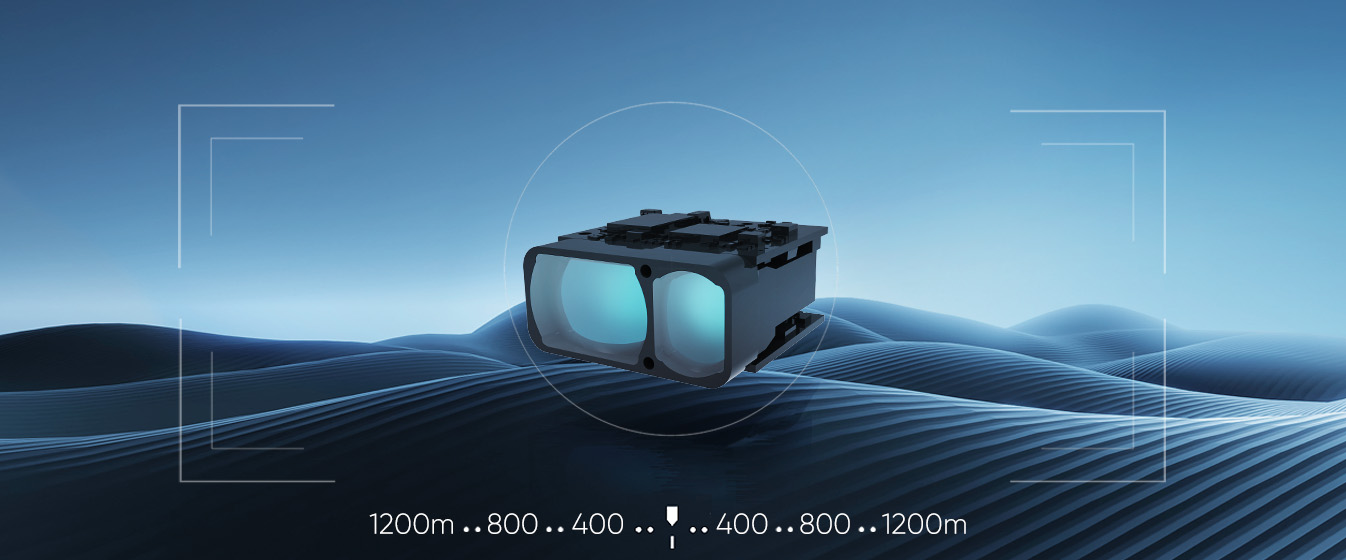
The TFA1200-L is a lightweight, compact kilometer-range single-point LiDAR that ensures eye safety. It is used in inspection drones, drone pods, and engineering surveys, providing distance maintenance and auxiliary position estimation functions.
Key specifications
Need help confirming a selection or purchase details?
| Parameter | Value | Parameter | Value |
|---|---|---|---|
| Measuring range | 3 ~ 1200 m | Detecting accuracy | 1% @ ≤ 200 m |
| Frame rate | 3 Hz | Interface | UART |
| Protection | Without enclosure | Dimensions | 25 mm × 25 × 13 mm |
| Power consumption | < 1.1 W | Weight | 11 g |
| Field of view | ~ 6 mrad | Output data | Single-point Distance Value |
| Operating voltage | DC 2.7 ~ 5.0 V |
Suitable for long-range UAV measurement, inspection and engineering surveying.
Condition: Bounded by the range, accuracy and operating conditions in the product datasheet.
TFA1200-L is not intended for measurements beyond this model's datasheet range, accuracy or interface limits, and is not a substitute for certified redundant safety systems.
Condition: If the target requirement exceeds the specification boundary, complete a selection review or contact technical support first.
The TFA1200-L has a detection range of 3 m to 1200 m, making it suitable for long-range applications. This extended range is particularly valuable for UAV gimbal integration, perimeter security, and overhead crane monitoring where distant target detection is critical. Accuracy at ranges up to 200 m is <1%, with a distance resolution of 10 cm throughout the operating range.
The TFA1200-L communicates via UART (TTL 3.3V) at a default baud rate of 115200 bps, with configurable 8 data bits, 1 stop bit, and no parity. It outputs 3.3V TTL signals and uses a proprietary binary command protocol (master-slave communication) for controlling ranging modes (single, continuous, standby) and retrieving distance measurements. The 6-pin interface includes dedicated UART_TX/UART_RX lines plus a POWER_EN control pin for module enable/disable.
The TFA1200-L is optimized for UAV gimbal integration, perimeter security systems, overhead crane hook collision prevention, and engineering surveying applications. Its compact 25×25×13 mm form factor and lightweight 11 g design make it ideal for payload-constrained platforms like drones. The long 1200 m range and high-precision dToF technology enable effective distance measurement even in varying target reflectivity and strong sunlight conditions.
The TFA1200-L delivers <1% accuracy at ranges ≤200 m with 6 cm repeatability in the same distance band. Distance resolution is 10 cm across the entire 3–1200 m range. These specifications are measured during outdoor daytime conditions with a 90% reflectivity target and the laser spot entirely on the target object, representing typical real-world operating conditions.
The TFA1200-L operates reliably from -40°C to +65°C, with a storage temperature range of -40°C to +70°C and maximum operating humidity of ≤70%. The sensor is rated for Class 1 eye safety per EN60825 and offers 100 KLux ambient light resistance, enabling robust outdoor daylight operation without interference. However, the datasheet does not specify an IP rating for water/dust ingress protection.
The TFA1200-L accepts DC power input from 2.7 V to 5.0 V, with typical average power consumption below 1.1 W at 25°C. This low-power design makes it suitable for battery-powered and energy-constrained applications such as autonomous drones and portable survey equipment. The POWER_EN pin (pin 6) allows software control of the module's power state via TTL 3.3V logic.
The TFA1200-L measures 25 × 25 × 13 mm (compact cubic footprint) and weighs 11 g ± 0.5 g. This ultra-lightweight and compact design is specifically engineered for integration into gimbal systems, fixed-wing UAVs, and other space-constrained platforms where minimizing sensor mass is critical for flight stability and endurance.
The TFA1200-L's 3 Hz frame rate (3 measurements per second) makes it unsuitable for real-time obstacle avoidance in fast-moving applications (rovers, autonomous vehicles, drones in rapid flight). The narrowly focused 6 mrad field-of-view cannot detect targets outside its beam; multiple sensors would be required for multi-directional obstacle detection. No IP rating means it lacks explicit weatherproof sealing—users should protect it from direct rain and submersion. The low baud rate and simple TTL interface limit integration with high-speed industrial networks.
The TFA1200-L is a single-point fixed-beam dToF sensor (6 mrad FoV) and is not directly comparable to the Lightware SF45, which is a rotating multi-beam 2D LiDAR. However, versus the Lightware LW20-A single-point rangefinder, the TFA1200-L offers superior range (1200 m vs. ~40 m), comparable power efficiency (<1.1 W), and similar UART interface. The TFA1200-L achieves its range through dToF pulsed laser technology (905 nm EEL source) rather than phase-shift or continuous-wave ToF, providing robust performance in daylight without requiring complex beam modulation.
The TFA1200-L integrates with any microcontroller, embedded system, or flight controller with UART capability: Arduino, Raspberry Pi, STM32, and PLC systems via standard serial communication. The TTL 3.3V interface is directly compatible with most single-board computers; no level-shifting is required. While not explicitly listed in the datasheet, the sensor's UART protocol supports master-slave commands for ranging modes, making it compatible with ROS (Robot Operating System) drivers and Pixhawk autopilots via standard telemetry adapters, though custom integration code will be required.