
News Updates · June 5, 2026
Benewake Launches VLS-H5 Underwater 360° LiDAR for Premium Pool Robots
Benewake introduces VLS-H5 underwater omnidirectional LiDAR, adopted by the MOVA Rover X10 for pool mapping, localization and obstacle avoidance.
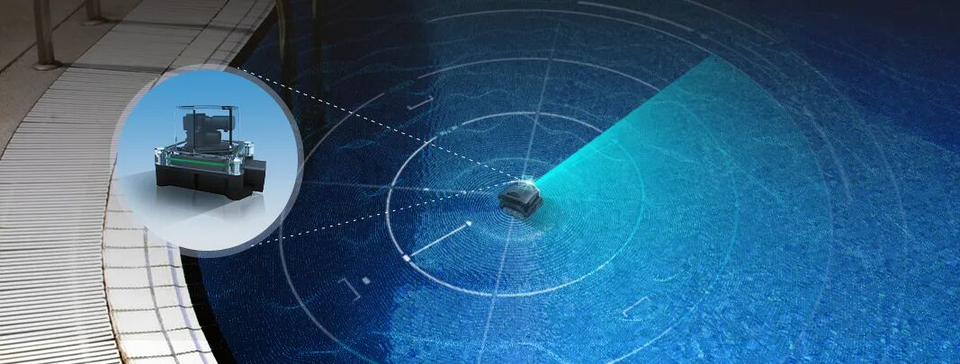
Pool-cleaning robots are quietly becoming an unsung success story in consumer robotics, with mature technology deployment and steady market adoption.
They may lack a futuristic appearance, but they work year-round in complex, real-world water environments. Their perception systems face demanding challenges: intense sunlight reflected from the water surface, penetration through turbid water, and optical-path distortion caused by currents and ripples. All place high demands on the stability and accuracy of localization, mapping and obstacle avoidance.
As intelligent pool-cleaning robots increasingly compete on specifications while delivering similar experiences, the questions that matter to users are becoming clearer:
Is mapping fast enough? Is localization accurate? Can the robot still work reliably in strong sunlight and dirty water?
The answers are changing.
Benewake has officially launched the VLS-H5, the world's first underwater omnidirectional scanning LiDAR to reach mass production at scale.
Meanwhile, Surge Future's premium MOVA Rover X10 pool robot has become the first product to adopt it. Equipped with enhanced vertical propulsion, the new robot can autonomously ascend, hover, descend and move horizontally underwater, like an agile underwater drone, bringing a new breakthrough to intelligent pool cleaning.
The MOVA Rover X10 is the first intelligent pool-cleaning robot equipped with VLS-H5 underwater 360° omnidirectional LiDAR.
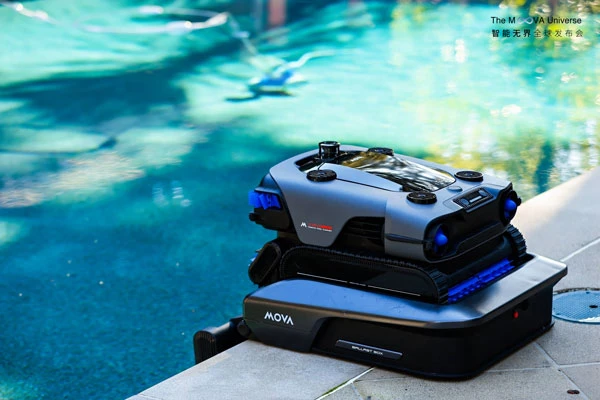
Unlike most products that can only map the pool floor and walls in two dimensions, the Rover X10 uses a LiDAR mapping system for real-time spatial perception and precise localization. The LiDAR sensor enables stable operation in pools with complex shapes, varying depths and numerous corners, with environmental recognition and navigation accuracy significantly better than camera- or sonar-based solutions.
This is more than a component upgrade: it is a generational advance in underwater perception.
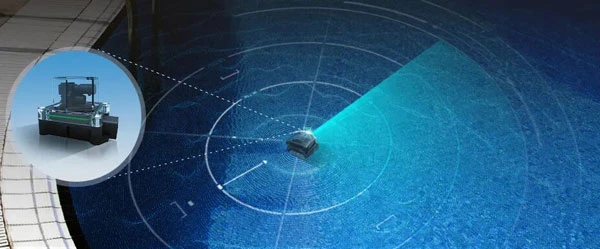
The VLS-H5 is becoming a key piece in bringing pool-cleaning robots into a truly intelligent era.
Built for underwater operation: resistance to strong light, turbidity and corrosion
Three core advantages address three challenges in underwater optical perception
Underwater environments put optical sensors to the test. Water absorbs laser light at certain wavelengths, intense midday sunlight reflects from the water surface, and suspended particles scatter light. Every optical perception solution must overcome these physical challenges.
The VLS-H5 is not an adaptation of a general-purpose product. It is a solution designed from the ground up for underwater optical perception, systematically addressing these challenges.
Resistance to strong light and turbidity
Stable operation even in extreme conditions
Frequent pool-cleaning use often takes place in intense summer midday sunlight.
In low-latitude European and North American markets, summer midday ambient light can exceed 100 KLux. Strong light introduces substantial background noise, lowers the LiDAR signal-to-noise ratio and can even saturate the receiver, overwhelming return signals and causing inaccurate ranging or lost targets. This is the point at which many LiDAR sensors stop working effectively.
Through coordinated hardware and software design, the VLS-H5 increases ambient-light tolerance to 160 KLux, providing ample margin. Even in pools exposed to direct sunlight, it continuously delivers stable, complete, high-quality point-cloud data, allowing robots to work confidently in bright conditions.
To address changing water quality, the VLS-H5 uses a Class 1 eye-safe visible-light laser source to significantly improve underwater penetration:
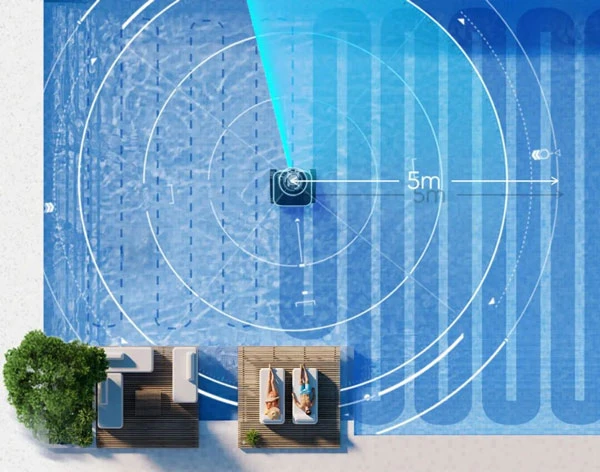
Clear water: a range greater than 5 m, covering more than 78 m² of pool area in a single scan.
Turbid water (NTU ≤ 4): an effective range of at least 1.5 m.
Measurement accuracy of ≤ 3 cm across the range, with localization accuracy unaffected by changes in turbidity.
Combined with dedicated algorithmic compensation, the robot can maintain drift-free localization, stay on its planned path and clean more consistently across water conditions.
Compact structure and high reliability
Designed for integration and long-term use
Premium pool robots have stringent requirements for both form factor and reliability.
Compact internal layouts often leave only about 5–10 cm of depth for the LiDAR. The optical window, connector and sealing must fit together within this limited space.
Within a compact 75 × 52 × 53 mm package, the VLS-H5 achieves IPX8 waterproof protection and supports long-term stable operation at a water depth of 4 m. Integration requires exposing only a few centimeters of the optical window, preserving the robot's appearance and significantly reducing the risk of impact damage.
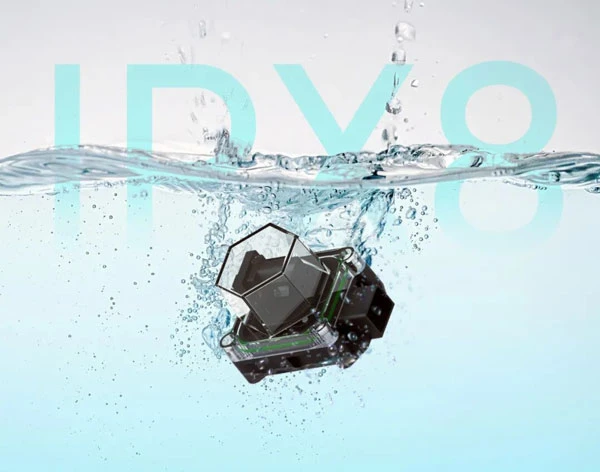
For real-world pool environments with corrosive conditions, strong UV exposure and abrasion, the VLS-H5 uses:
Dedicated corrosion- and UV-resistant materials.
High-transmittance optical coatings.
A waterproof aviation-style connector.
Strict airtightness testing for every unit before shipment.
From design to manufacturing, these safeguards serve one goal: easy integration, less maintenance and a long service life.
Replacing inefficient mapping with flexible, full-coverage 360° scanning
Making pool robots truly intelligent.
The value of the VLS-H5 goes beyond basic operation: it creates a substantial difference in the user experience.
One-second mapping: see the whole pool without circling its perimeter
Traditional pool robots often map by following the pool boundary, a slow process with inconsistent success rates.
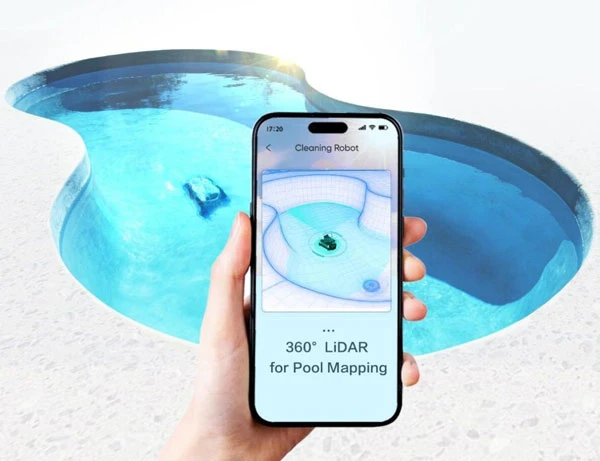
With 360° scanning, a 6 Hz refresh rate and a supporting SLAM algorithm, the VLS-H5 enables an almost immediate full-pool mapping experience in typical private pools:
No prolonged trips around the pool perimeter.
A significantly higher first-attempt mapping success rate.
A clear, complete pool outline appears in the app sooner.
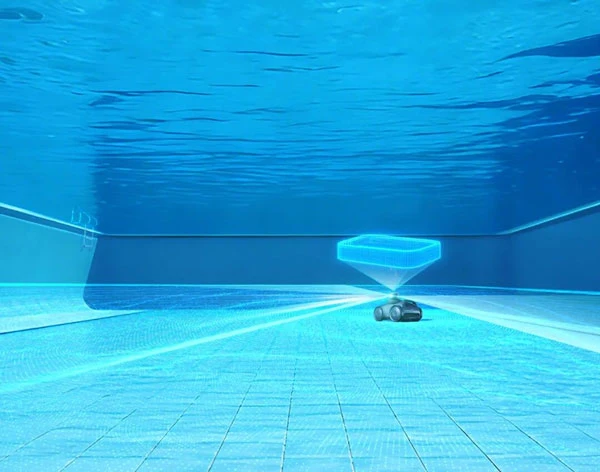
Each VLS-H5 undergoes individual modeling and calibration, covering more than 10 common pool-wall materials, including cement, mosaic tiles and marble. Across different reflectivities and normal turbidity conditions, it maintains measurement accuracy at the ±3 cm level, providing a dependable foundation for path planning.
Centimeter-level localization: accurate movement and seamless task resumption
During cleaning, the VLS-H5 continuously measures the robot's distance to pool walls and reference objects, comparing measurements against the SLAM map in real time. It provides centimeter-level localization with repeatability better than 2 cm, effectively correcting accumulated inertial-navigation error.
This directly improves the cleaning experience:
More stable movement with less unnecessary oscillation.
Higher cleaning efficiency.
Accurate path resumption after an interruption, avoiding large uncleaned areas.
A long range of 5 m and stable ranging at incidence angles approaching 80° reduce accumulated error in areas without localization data, supporting reliable operation in large or structurally complex pools.
360° obstacle avoidance: closer edge cleaning, greater safety and fuller coverage
The VLS-H5 keeps its blind zone within 10 cm. Combined with 360° omnidirectional scanning, it acts as an always-on environmental lookout:
Detecting obstacles at a distance in every direction.
Simultaneously sensing the spatial structure around obstacles.
Planning deceleration and detours in advance.
The laser's strong directionality identifies small obstacles and reduces missed detections. Without ultrasonic multipath interference, false detections are significantly reduced.
During edge cleaning, high accuracy and a small blind zone let the robot approach pool walls closely while avoiding collisions, improving both coverage and safety.
More than a technology upgrade: a practical path to differentiation for brands
For pool-cleaning robot brands, the VLS-H5 offers a set of deployable competitive advantages:
Premium differentiation: one-second mapping, stable operation in extreme conditions and cleaning with almost no blind zones become key selling points for high-end models.
Faster global expansion: CE, FCC, FDA and RoHS certifications, together with Class 1 eye-safety compliance, support entry into mainstream European and North American markets.
Lower development and after-sales costs: in-house underwater algorithms, compact integration and reliable construction reduce additional development and repair demands.
Stronger user satisfaction: an intuitive, convenient experience delivers more consistent cleaning results.
Benewake VLS-H5 × MOVA Rover X10: defining a new standard in underwater intelligent perception
The debut of the MOVA Rover X10 with Benewake VLS-H5 showcases the latest advance in underwater perception for pool-cleaning robots.
This LiDAR was built for pool robots, and it is a key part of helping manufacturers differentiate their products and move into the premium segment.
Steady progress: turning accumulated engineering strength into a breakthrough
Benewake is a deep-tech company focused on being the eyes of robots and becoming AI infrastructure for the physical world.
Building on LiDAR technology, we focus on high-growth robotics applications and develop the perception layer for the next generation of artificial intelligence, helping machines understand and interact with the physical world.
As a leader in bringing robot perception to scale, Benewake has applied automotive-grade LiDAR reliability to underwater cleaning at scale and continues to expand into outdoor mowing, embodied intelligence and logistics robots. As a leading global supplier by pool-robot LiDAR shipments, we are working with leading customers to define new standards in robot perception.
Benewake's executive team consists of PhD graduates. CEO Yuan Li studied under Academician Xu Xurong, one of the founders of luminescence research in China, and received his PhD from Wake Forest University in the United States. CTO Da Shu earned his PhD in an optical-engineering-related field at Paris-Saclay University in France. This scientific background underpins the company's steady, reliable approach to research, product launches and customer partnerships.
Benewake CEO Yuan Li said:
We have established mature delivery capabilities for pool-robot LiDAR. Our VLS-H5 underwater 360° omnidirectional solution has completed its first mass-production delivery with MOVA. We will introduce several more products in the future.
Lei Huang, Global Head of MOVA Intelligent Pool Robots and President of Surge Future, said:
Our close collaboration with Benewake is an important part of our strategy in intelligent perception. Benewake's LiDAR technology gives us more precise environmental perception. This partnership has brought a key breakthrough in underwater perception and environmental recognition, delivering a more efficient, intelligent cleaning experience for users and taking pool cleaning from automation toward true intelligence.