
Media Coverage · June 5, 2026
The Eyes of Robots: Benewake Expands from Underwater Sensing to Global Markets
Caijing New Media reports on Benewake’s underwater LiDAR development, robot-perception strategy and expansion into overseas markets.
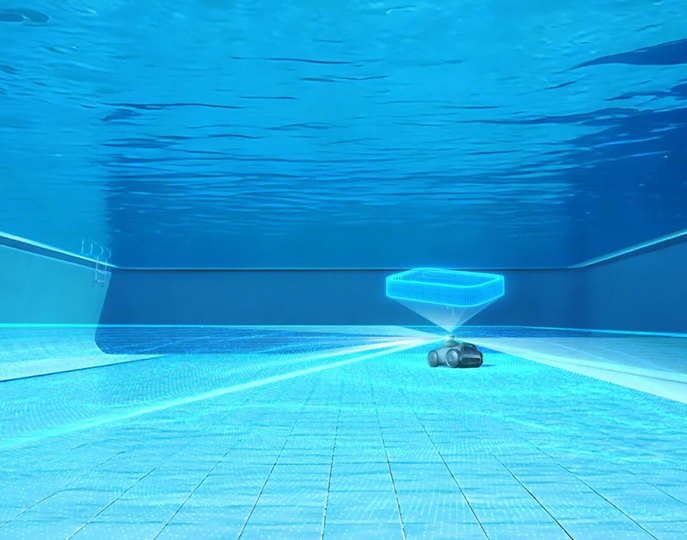
Source: Caijing New Media
By Liu Fen | Edited by Jiang Shizhou
There were 32.9 million swimming pools worldwide in 2024, mainly in Europe and North America. China Insights Consultancy forecasts that the total will rise to 39.3 million by 2029, with pool-cleaning spending reaching US$16.7 billion.
An industry estimate illustrates the economics: during peak season, pools are usually cleaned once or twice a week. Hiring someone costs RMB 50–200 per visit and can add up to nearly RMB 10,000 a year. A pool-cleaning robot usually costs RMB 2,000–8,000, offering clear economic benefits over long-term use.
Yet pool-robot penetration was only 26.2% in 2024. Consumers are interested, but the products are not yet easy enough to use. Seeing underwater requires overcoming three physical challenges at once: water absorption of laser wavelengths, sunlight reflected from the water surface and scattering by suspended particles. Most pool-cleaning robots still map by exploring along the boundary, like a person feeling their way with their eyes closed. The result is low efficiency, missed areas and a poor experience, still far from advanced intelligence.
A Chinese LiDAR company is working to change this. Its name is Benewake.
The MOVA Rover X10 is among the industry's first intelligent pool robots equipped with underwater omnidirectional LiDAR. It has attracted attention for moving beyond the limitations of traditional two-dimensional cleaning. This is enabled by multisensor fusion combining LiDAR, cameras, inertial navigation and water-flow sensing. Benewake's VLS-H5, the world's first underwater omnidirectional scanning LiDAR to reach mass production at scale, is a crucial part of this system.
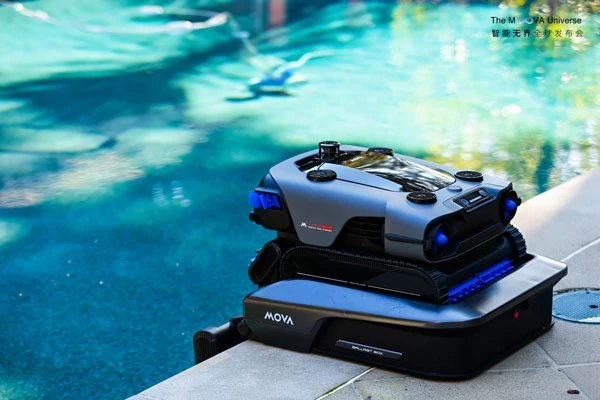
LiDAR is one of the few solutions capable of maintaining centimeter-level localization accuracy in turbid water. But entering underwater applications requires more than adding a product line: it means rebuilding the entire underwater optical stack. Benewake took a new approach. Rather than modifying a general-purpose LiDAR for water, it redesigned the VLS-H5's optical window, laser wavelength, scanning structure and sealing process. This addresses a core difficulty for pool robots, allowing them to see clearly and comprehensively. The advance in underwater perception has directly supported shipment growth. To date, Benewake has delivered more than 100,000 underwater LiDAR units in batches to pool-robot customers, placing it among the global leaders.
“Advanced intelligence needs advanced perception,” said Benewake founder and CEO Yuan Li. He sees a larger market: large models give robots a brain capable of understanding, reasoning and making decisions. But to enter the physical world and avoid obstacles, grasp objects and navigate, robots also need eyes that can directly understand their surroundings. That is what Benewake is developing.
Benewake has designated 2026 as its “year of robotics” and introduced a new mission: being the eyes of robots and becoming AI infrastructure for the physical world. Across air, land, water and road applications, any role as a robot's eyes is a direction the company is interested in.
The underlying shift is an extension of Benewake's automotive-grade capabilities into multiple robotics applications. A company representative told us that underwater perception is difficult, Benewake entered early and its customers were already serving overseas markets. Underwater applications are therefore the first deployment at scale in this expansion, with mowing, embodied intelligence and logistics to follow. The broader opportunity is the overseas expansion of core components driven by Chinese equipment manufacturers, a market much larger than underwater applications alone.
The rise of Chinese equipment manufacturers is reshaping the global premium market. Benewake aims to provide the core perception layer in that transformation, benefiting from China's overseas expansion while helping define the sector.

Turning to robotics in search of a new growth curve
Robotics offers ample possibilities, but a focus on core perception still faces practical questions: Is there real mass-production demand? Which segments deserve investment? Can the business model become sustainable?
Benewake's approach has always been to work backward from the market to technology. First, establish whether there is real demand and willingness to pay; then determine the required technical performance; finally, assess whether costs can support the market.
Yuan Li believes two signals are especially persuasive when the company is uncertain. The first is demand from leading industry customers. Benewake began working on underwater LiDAR in 2024, but committed to a premium omnidirectional version such as VLS-H5 when leading customers approached it about cooperation, demonstrating a real market. The second is whether the company's product can solve end users' pain points, the strongest signal of product-market fit.
Over a decade, Benewake has grown from a little-known company into a leader in its segments, partly by identifying underserved markets. Its development follows a repeatedly tested method: closely tracking market changes, continually researching customers and suppliers, collecting industry data, understanding penetration rates, judging market developments from the data and rapidly adapting.
The founding team supports this approach. Its members combine deep academic and industry experience with research capabilities from leading universities in China and overseas. Founded in 2015, Benewake entered industrial and rail-transport LiDAR, accumulating years of experience in drones, robotics and intelligent transportation and gaining a leading position in transport and industrial sensing. After achieving mass production in transportation, it transferred that experience to automotive applications and helped advance China's automotive-grade LiDAR toward very high line counts.
China's automotive LiDAR market has undergone major consolidation over the past three years. By 2026, Huawei, RoboSense and Hesai together account for more than 90% of the factory-installed market. In this context, Benewake has pursued a strategy of developing capabilities through domestic competition and earning profits overseas. Beyond automotive applications, its products serve more than 100 specialized application scenarios and are exported to more than 100 countries. Facing rising volumes, falling prices and pressure on automotive LiDAR margins, the company began expanding into robotics over the previous two years, extending automotive-grade capabilities into multiple robot applications.
Its robot-perception product lines span four domains: air, land, water and roads. Air covers drones, or flying robots; land includes mowing robots and embodied intelligence; water covers pool-cleaning robots; and roads cover autonomous vehicles. LiDAR for drones and pool-cleaning robots is already a mature business. The automotive-grade AD series continues to expand its applications, while mowing robots and embodied intelligence are emerging areas for future development.
Robot LiDAR is accounting for a rapidly increasing share of Benewake's revenue. New revenue in 2026 mainly comes from various robotics applications. Its share of research spending devoted to robotics is comparable to that of industry leaders. Its technical approach covers the full stack: optics, mechanics, electronics, software, algorithms, production and certification. Differentiation is built across the stack rather than in just one layer.
To balance performance and cost, Benewake combines in-house chip development with close co-design alongside leading customers. The VLS-H5 was developed with MOVA by working backward from customer use cases and defining cost-performance trade-offs during design to avoid later rework.
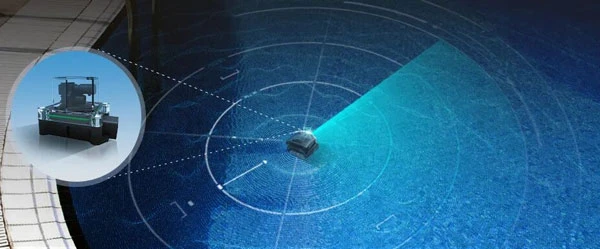
In Benewake's view, robot perception is fragmented but offers enormous growth. It needs focused companies that work deeply with customers to define solutions, rather than one company doing everything. The depth of Benewake's expertise in several robot segments would be difficult for a large competitor to catch up with quickly. Many major companies themselves began by leading a specialized market.
Solving underwater challenges: from basic operation to a generational advance
Shipment figures show that Benewake seized an early opportunity in pool robots and established a clear lead. Underwater LiDAR shipments rose from fewer than 10,000 units in 2024 to nearly 100,000 in 2025, a tenfold increase that placed it among the global leaders.
Why had others not achieved this earlier? Two direct reasons stand out: most companies had not entered the market, and those seeking to do so faced a substantial technical threshold.
Camera vision struggles in turbid water and sonar lacks sufficient precision, making underwater environments a natural application for LiDAR, but a very difficult one. Water absorption, strong reflected light and particle scattering are compounded by the fact that light travels through water at about 75% of its speed in air. The resulting differences in optical parameters require redesigning the optical window, laser wavelength and scanning structure.
Benewake spent two to three years developing this engineering experience and patent portfolio before launching the VLS-H5. Compared with similar overseas underwater LiDAR products, it is an end-to-end optimization of the perception system from optics to algorithms, rather than simply a waterproof adaptation of a general-purpose sensor.
Its breakthroughs fall into three areas. First, resistance to intense light: conventional underwater LiDAR ambient-light tolerance is 100 KLux, while VLS-H5 reaches 160 KLux. The article reports that no other underwater LiDAR had publicly demonstrated this level. This enables stable point-cloud output under direct summer midday sunlight in low-latitude European and North American markets.
Second, performance in both clear and turbid water: a range greater than 5 m in clear water covers more than 78 m² in one scan. In turbid water (NTU ≤ 4), it maintains an effective range of at least 1.5 m and measurement accuracy of ≤ 3 cm across the range. This combination covers mainstream pool sizes, from private pools to small and medium commercial pools.
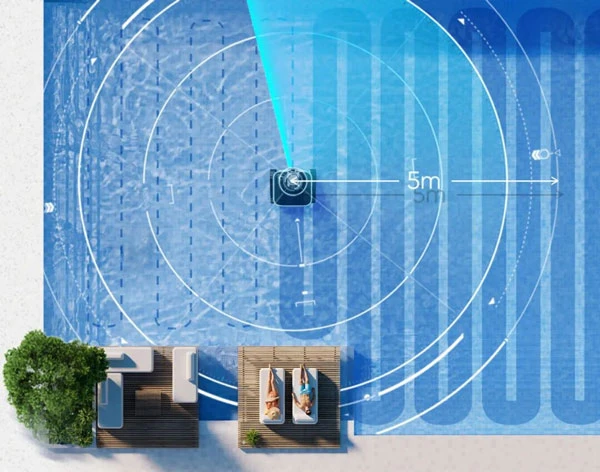
Third, omnidirectional perception and one-second mapping: the VLS-H5 enables real-time spatial perception and centimeter-level localization, supporting stable operation even in complex pools.
Close customer collaboration and rapid iteration form another competitive barrier.
The VLS-H5 completed its first mass-production delivery with the MOVA Rover X10, incorporating both companies' accumulated understanding of real applications. The project took about one year from initiation to launch, an exceptionally fast pace for underwater LiDAR.
Two hurdles were especially demanding. MOVA wanted genuinely premium, flagship-level underwater perception, requiring the product to be defined from customer use cases rather than selected from a supplier's specification sheet. And building one unit in a laboratory is very different from producing at scale. Benewake tests the airtightness of every unit before shipment and applies manufacturing processes adapted from its automotive-grade mass-production experience.
Chinese pool-robot manufacturers now iterate faster than overseas competitors. A MOVA representative said overseas companies typically need two to three years, compared with one to two years for Chinese companies. MOVA's first pool robot took 10–12 months from project initiation to launch, while its second generation took only eight months. This advantage comes from reusing capabilities rather than starting from scratch.
A new generation of Chinese pool-robot manufacturers expanding overseas, including MOVA and Beatbot, is targeting premium flagship models. LiDAR is becoming a standard sensing component in premium products and is entering consumers' awareness. In addition to MOVA and Beatbot, Benewake works with leading pool-robot manufacturers including Dreame and Wangyuan Technology. Benewake is itself a fast-moving upstream supplier.
Yuan Li identifies three reasons the company can keep pace with customers. First, a platform-based product architecture: it does not build a new LiDAR from scratch for every customer, but uses a core optical engine and in-house SPAD chipset as a foundation with a modular configuration layer. New customer requirements change that layer, rather than the underlying platform. Second, in-house chips give the company control at the component level. Third, an efficient expert team works across optics, mechanics, electronics, software, algorithms, production and certification in a single building, shortening decision chains and reducing information loss.
Underwater technology is still evolving, he said, and Benewake will continue improving optical perception. A remaining bottleneck is iteration of underwater sealing processes. This is a physical manufacturing challenge that software cannot accelerate; modular packaging and automated production lines are the routes to improvement.
Benewake's willingness to tackle these difficulties comes from its experience with complete LiDAR systems and its ability to reuse automotive-grade mass-production capabilities.
From the automotive-grade AD series to the underwater debut of VLS-H5, the same underlying technology has taken different forms. Both automotive and underwater applications require reliable optical perception in extreme conditions, supported by automotive-grade reliability and a complete optical technology stack.
The team also expects its full-stack underwater methodology to transfer quickly to mowing, embodied intelligence and logistics. The same resistance to strong light can counter intense sunlight in outdoor mowing; the same waterproofing expertise can support all-weather operation in embodied intelligence.
Expanding overseas: being present and taking root in the ecosystem
As an upstream perception-component supplier, Benewake is a direct beneficiary of the robotics wave. Its underwater LiDAR success also reflects years of work in overseas markets and the natural extension of those capabilities.
The founding team has extensive overseas experience, and the company has operated with a global outlook from its first day. Overseas revenue now accounts for more than 70% of its total, a leading position within the industry.
Its logic is clear: intense competition in China's LiDAR market drives full-stack capabilities in hardware, algorithms and manufacturing processes. These capabilities command higher margins and deliver more value overseas, a typical path for Chinese deep-tech companies expanding internationally.
Interestingly, the trust Benewake has built abroad did not come from remote email exchanges alone.
A Turkish customer once used a competitor's quotation to seek a lower price: the other supplier charged US$80 while Benewake charged US$100. A Benewake salesperson replied: “Do you trust them? We meet several times a year, but you have never met them. If they take the money and disappear, can a US$20 saving cover your loss?”
The customer ultimately ordered at US$100. Benewake CMO Junyun Qi said the validation period and adjustment costs of switching suppliers are much greater than the hardware price difference. Trust is scarcer than low prices in overseas markets, and trust requires being physically present.
Before 2023, Benewake's overseas sales resembled traditional foreign trade: standardized products, email communication and customers who might not meet the team even once a year. The team subsequently found this model increasingly ineffective. Customers compared lower-priced competing products, while Benewake had no opportunity to explain its offering in person.
The company therefore began sending its teams abroad. Sales leaders and their teams travel from Turkey to Europe and from the United States to South America, spending at least half of each month overseas. Distributors can sometimes arrange four customer visits in one day, far more efficiently than before. “We used to communicate remotely; now we are physically putting down roots,” Qi said. Proximity improves both efficiency and trust.
Beyond trust, Benewake has two further advantages overseas.
The first is distribution. It has established a network of nearly 100 distributors covering more than 100 countries and works with global distribution leaders such as Digi-Key, making LiDAR as convenient to buy as electronic components.
The second is deep integration into open-source ecosystems. Its TF series supports seamless integration with commonly used open-source drone flight-control platforms such as ArduPilot and PX4: plug-and-play, with no additional development required. Drone developers following a standard open-source flight-control workflow therefore naturally encounter Benewake products. The company describes this as building an ecosystem barrier at the foundational level; replacing it would mean changing developers' established workflows.
Certification requirements are also addressed early. European and North American robot products compete on stability, certification and durability. Benewake has passed CE, FCC, FDA and RoHS certifications, incorporating requirements during design rather than adding them after the product is complete.
Overseas expansion has nevertheless faced challenges. The article reports that US tariffs on Chinese LiDAR had risen from zero to 60%–70%. Benewake responded by changing its quotation terms to EXW, or ex works, under which customers bear the tariffs, while accelerating expansion into Canada and South America. It has also become more cautious about risk, requiring payment before shipment from overseas customers other than major Fortune Global 500 companies such as Amazon.
Localization represents a larger change. Benewake plans to establish overseas factories over the next three to five years. “This is a necessity, not an option,” Qi said. Countries such as the United Arab Emirates require local employees and production for certain tax benefits or government projects, while European customers are also explicitly requesting localized supply chains.
Its international expansion will therefore move from selling products to building capabilities: hiring local employees, establishing local production lines and complying with local requirements.
“How can Chinese core robotics components maintain global competitiveness? This is planning ahead, not anxiety,” Yuan Li said. Continued investment in research, overseas distribution and European and North American certifications supports Benewake's ambition to establish itself as a benchmark for Chinese LiDAR companies expanding abroad. It hopes to be recognized as an explorer and innovator in global robot-perception solutions.
Anticipating customer needs and defining specialized markets
Across the global LiDAR industry, several overseas giants have fallen while Chinese companies have captured most of the market. From standard equipment in family cars priced around RMB 100,000 to the eyes of humanoid robots and navigation for driverless delivery vehicles, LiDAR applications continue to expand. It is becoming a key perception component in the era of AI and intelligent devices.
Soochow Securities notes that as robots move into open environments, the number of LiDAR sensors per robot may rise from one to three. The robot LiDAR market could reach RMB 28 billion by 2030, with a compound annual growth rate of 67.9%, potentially creating several markets comparable to passenger vehicles. Unlike automotive applications with thin margins and large volumes, overseas robot LiDAR offers higher gross margins and can be a major source of profits.
Benewake's strategic direction is clear: it aims to go beyond being a LiDAR manufacturer to become the eyes of robots and AI infrastructure for the physical world.
In Yuan Li's description, LiDAR is the means; the real offering is perception that lets robots see and understand their surroundings. This capability extends downward into hardware and upward into algorithms and models. Traditional LiDAR produces point clouds and cameras produce images, both raw data requiring further processing. Benewake is moving perception and understanding earlier into the sensing process, turning ranging devices into a robotic visual cortex. Its next-generation AI sensor product is planned for a future stage.
The company uses a network of capabilities to serve many vertical markets. Its non-automotive categories alone include robotics, intelligent transportation, agricultural IoT and industrial sensing. This breadth forms a distinctive competitive barrier, making it difficult for competitors to reproduce the same range of application experience and accumulated data quickly.
The value proposition is to create value for customers, their customers and the industry. When customers discover new applications, Benewake develops its products alongside them.
Junyun Qi gave several examples. The United States has more than one million farms, each with 20–30 silos. Workers traditionally climb up to measure remaining material with a ruler; the article reports more than 200 deaths annually associated with this practice. Benewake LiDAR costing tens to hundreds of dollars replaces that dangerous measuring method.
At Auckland Airport in New Zealand, a parking-guidance tender required 97% accuracy; bidders below that threshold could not participate. Benewake achieved 99.99%, giving it a decisive advantage, with contracts lasting five to ten years. In another application, overseas customers bought low-cost Benewake sensors and built obstacle detectors into canes for people with visual impairments, providing vibration alerts.
Benewake might not have anticipated these applications itself. “Often customers buy a product, use it and tell us it can also work this way,” Qi said. Such discoveries are not simply luck. The company standardizes its products and makes them easy to obtain, while serving enough specialized applications to build confidence in new requirements. Experience across more than 100 scenarios is harder to reproduce than a strategic plan.
When asked which company it looks to as a benchmark, Benewake names Japan's Keyence rather than a LiDAR competitor. Keyence is a global leader in industrial sensors. It sells directly rather than through distributors, sending sales engineers to production lines to configure equipment and gather requirements firsthand. It can define industry standards, and customers accept premium prices because subsequent operating costs are low.
Benewake hopes to anticipate customer needs and play a similar role in robot perception. “In underwater applications, we can already tell customers whether a requirement is too far ahead of current needs or whether it reflects a real need. We can help them make that judgment,” Qi said.
Behind this is a transferable set of foundational capabilities. From drones and transportation to automotive applications, from automotive to underwater operation, and then to mowing and embodied intelligence, each transition reuses the full technology stack rather than starting over. This ability to transfer capabilities is central to a deep-tech company's resilience across technology cycles. With a decade of experience, more than 100 application scenarios and over two million LiDAR units delivered, Benewake has turned long-term research investment, productization and early preparation into an established path.
Its story reflects Chinese deep-tech companies moving from followers to leaders: building capabilities through domestic competition, realizing value overseas, finding opportunities in robotics beyond automotive markets and working deeply in specialized applications. As more Chinese companies establish their technologies, develop their products thoroughly and build competitive strengths around real customer needs, Chinese manufacturing becomes more than a byword for value for money: it becomes indispensable engineering strength within the global supply chain.